EDC: The TBI Tracking Kit
Low Noise, High Signal — A System Built for a Broken Filter
The Philosophy
Here's the operating principle behind everything in this kit: low noise, high signal. Get data when you need it. Eliminate everything you don't. That's it.
I spent years in a DoD environment where smartwatches weren't an option. No wrist buzzing during briefs. No glancing at notifications in a SCIF. You wore a watch that told the time, and your phone stayed in a locker. What I didn't realize at the time was that those years were training me to appreciate something most people never think about — analog reliability. The quiet simplicity of a tool that does one thing and doesn't ask for your attention while doing it.
Then the TBI gave me a neurological reason to stay there.
I'm not anti-tech. I run a training site. I build tools with AI. I use a recovery ring that talks to my phone. But I am anti-interruption — because for a brain with limited cognitive bandwidth, every unnecessary notification spends currency you don't have. A buzz on your wrist isn't free. It costs focus. It costs transition time. It costs energy your brain may not get back for a while. That's the tax most people don't see.
The kit I carry is designed around that reality. Nothing buzzes uninvited. Every item either captures data passively or forces intentional engagement. It's the same principle behind the 2-terminal rule I use for AI work — limit the inputs, protect the processing power.
The Workout Watch: Garmin epix Pro Gen 2
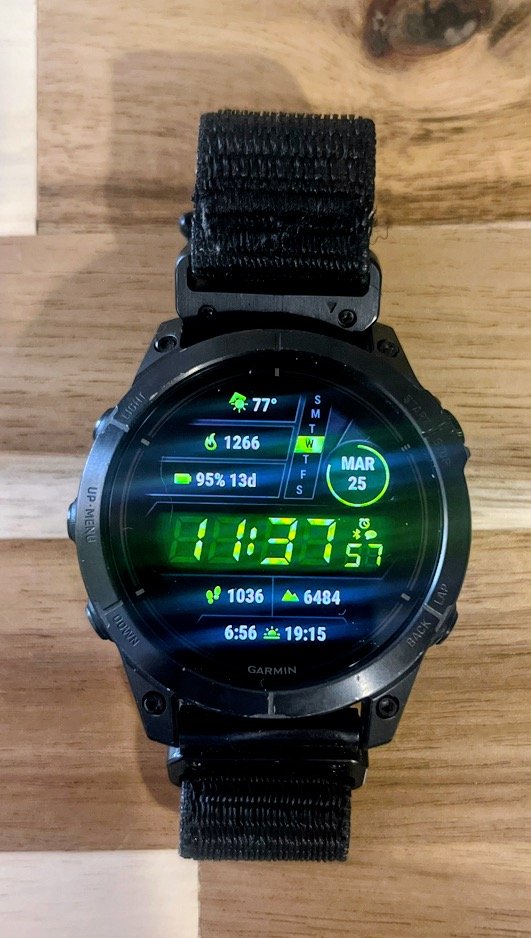
Garmin epix Pro Gen 2
The Garmin is a beast. I chose it for Garmin's reputation in the fitness tracking space, but what kept me was the build quality. It has that G-Shock-esque ruggedness to it — this thing can take a hit. The AMOLED display is sharp enough to read mid-set without squinting, and the built-in light is a real asset for early morning runs when it's still dark out.
For sessions, it's great. Heart rate tracking, workout logging, the whole picture. But here's the thing — it's still a smartwatch. The second it's connected to my phone, it rings off the hook. Texts, emails, app alerts — the full fire hose aimed directly at my wrist. I know I could go into the settings and turn all that off. But I'd rather just take it off.
So that's how it works. The Garmin goes on when the session starts and comes off when the session ends. It's a high-data tool inside a defined window. Outside that window, it goes back on the shelf. That boundary is intentional. A smartwatch that's always on your wrist is always competing for your attention. I'd rather give it a job, let it do the job, and then dismiss it.
The Daily Drivers: Casio G-Shock 6900 & 5610
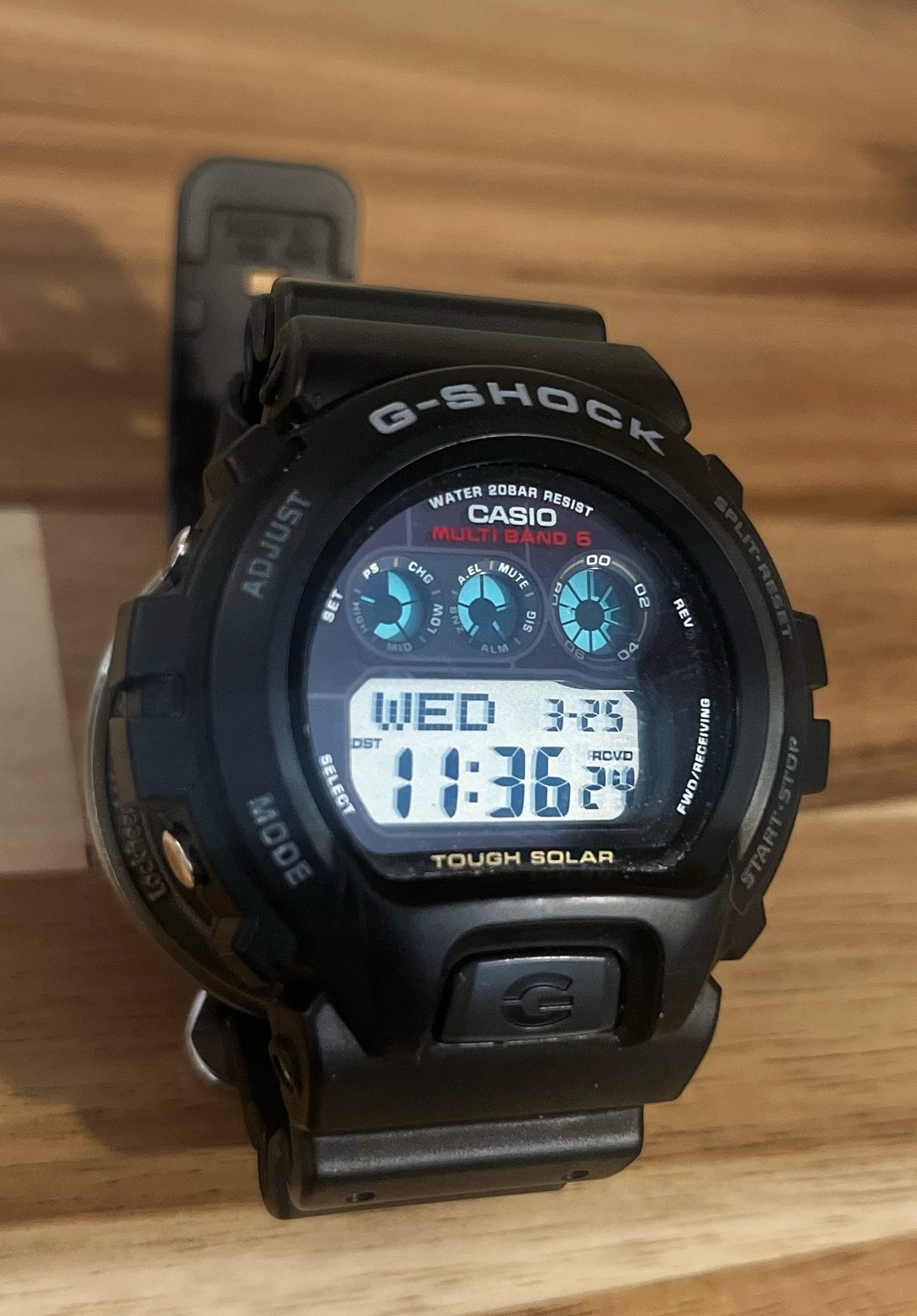
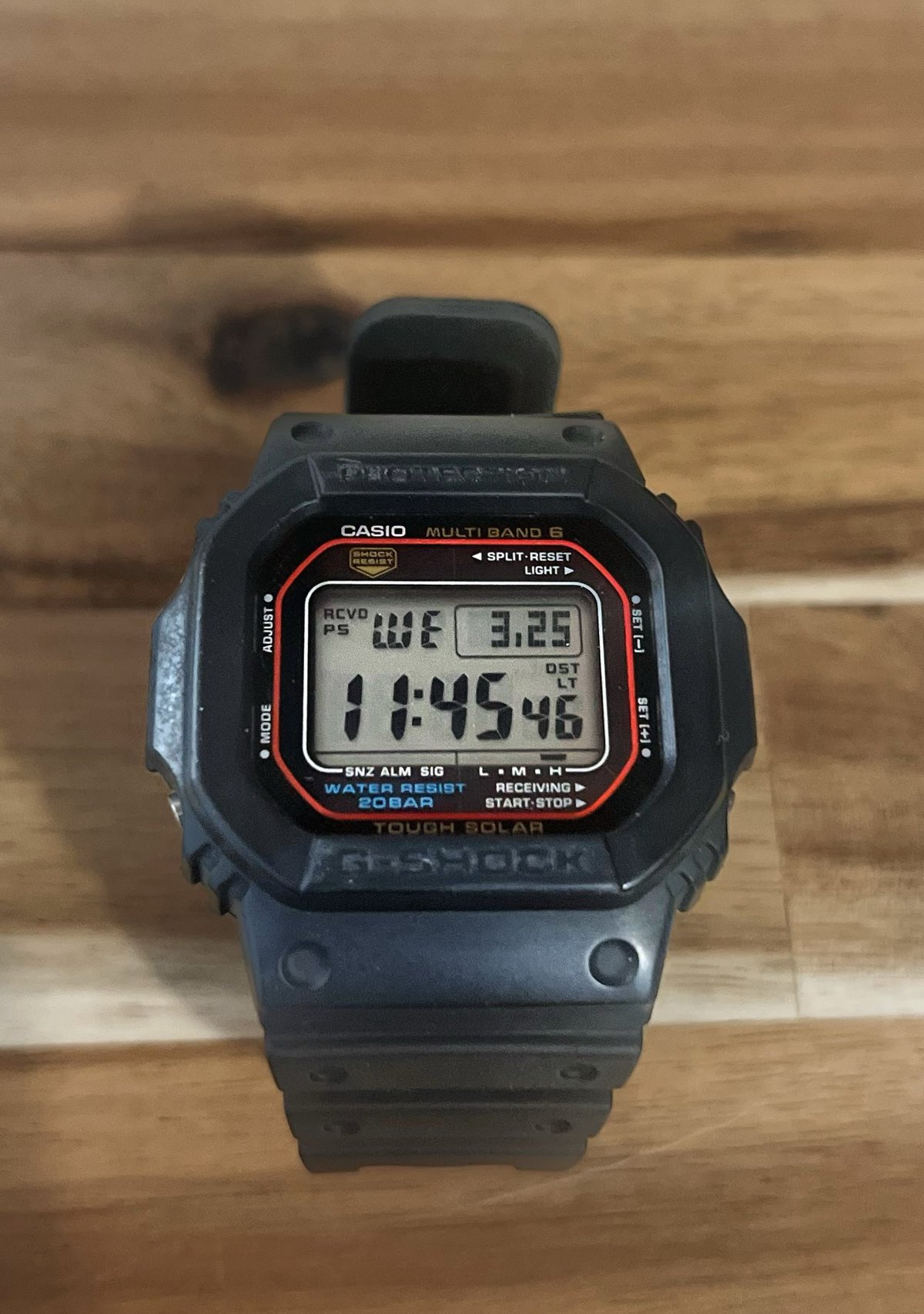
Casio G-Shock (DW-6900 / GW-5610)
Everything I need and nothing I don't. That's the G-Shock in one sentence.
These are the watches I reach for every morning. They tell time. They have a stopwatch. They have an alarm. They don't buzz 200 milliseconds after my phone vibrates in my pocket. They're not pinging me about stand goals or asking me to breathe. They are true tool watches — use them when you need them, ignore them the rest of the time, and they'll outlast everything else you own.
For someone with TBI, that silence is worth more than any feature a smartwatch could add. Every notification is a context switch. Every context switch costs cognitive energy. And that energy doesn't regenerate on the same schedule it does for everyone else. The G-Shock respects that. It sits on your wrist, does its job, and never once asks for your attention.
The collection between the 6900 and the 5610 is, as I like to say, virtually bomb proof across the board. I'm a self-admitted watch nerd — I follow Watches of Espionage, I watch Mad Watch Collector on YouTube with my girls, and I genuinely enjoy those videos of guys restoring old automatic timepieces. I don't have expensive tastes, but I appreciate the uniqueness of each piece. The G-Shocks are the backbone of the rotation because they deliver maximum reliability at zero cognitive cost.
The Field Watch: Citizen Eco-Drive
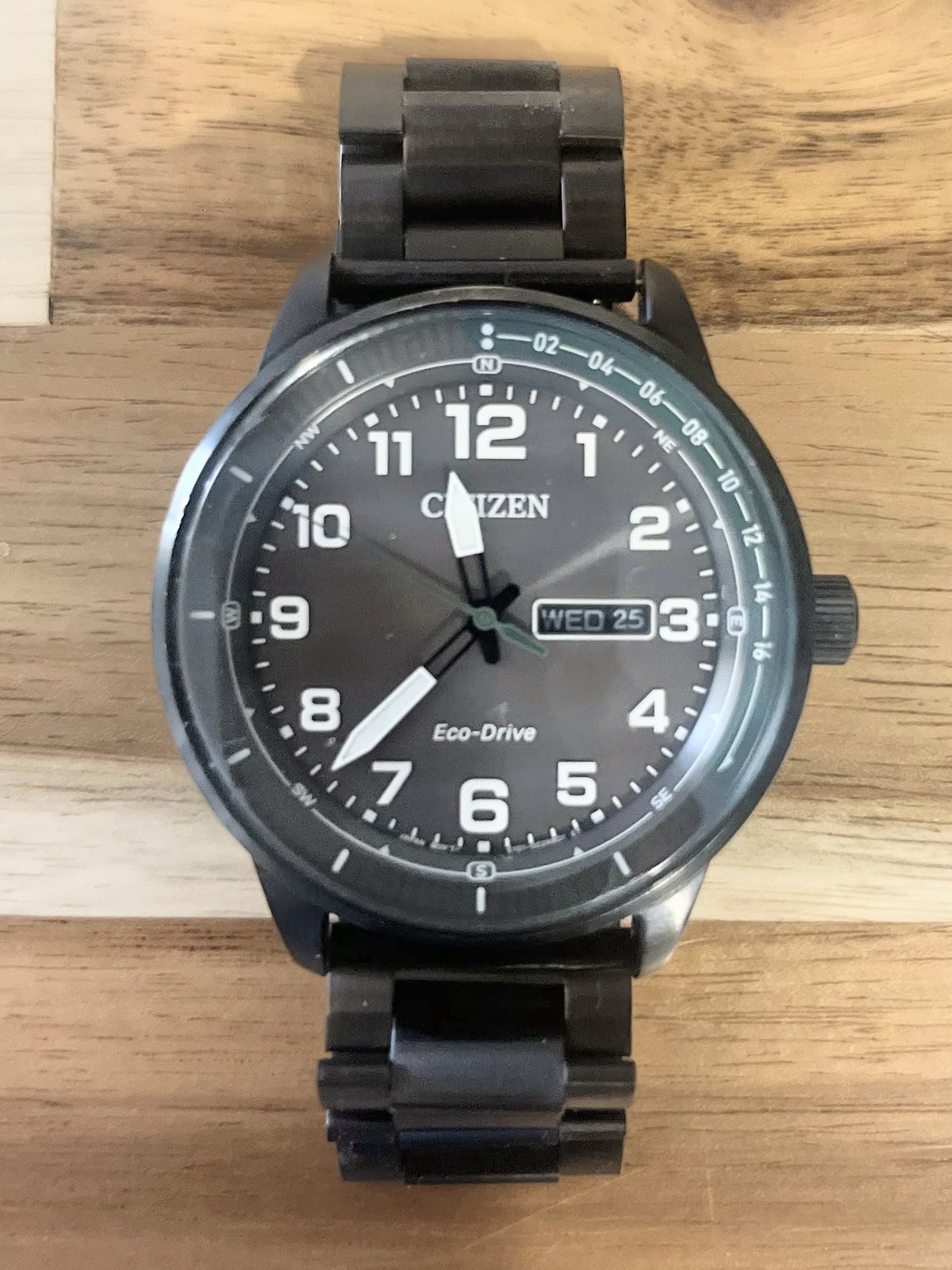
Citizen Eco-Drive Field Watch
The Citizen comes out when I'm feeling a little fancier — wearing a collar at work, headed to something that calls for a cleaner look. It's not a dress watch in the traditional sense, but it's simple, well-sized, and doesn't get in the way. Black dial. Solar powered. Citizen's Eco-Drive technology is top notch — no battery swaps, no charging cables, just light doing its job. Same philosophy as the rest of the kit: low maintenance, high reliability.
But the reason this watch is in the rotation has nothing to do with specs.
I bought this watch with my work mentor, not long before he passed. We were out together, I was looking at watches — because of course I was — and this one caught my eye. He was the kind of guy who appreciated simple things done right. We talked about it, I picked it up, and that was that.
Now it carries something no smartwatch ever could. When I put it on, it's not just a watch. It's a reminder of someone who shaped how I think about work, about showing up, about the kind of man I'm trying to be. Some tools carry data. This one carries history. And that matters more than any heart rate graph or notification feed.
Keep reading the mission log
New intel every Sunday // No spam
The Ring: Oura Gen 4
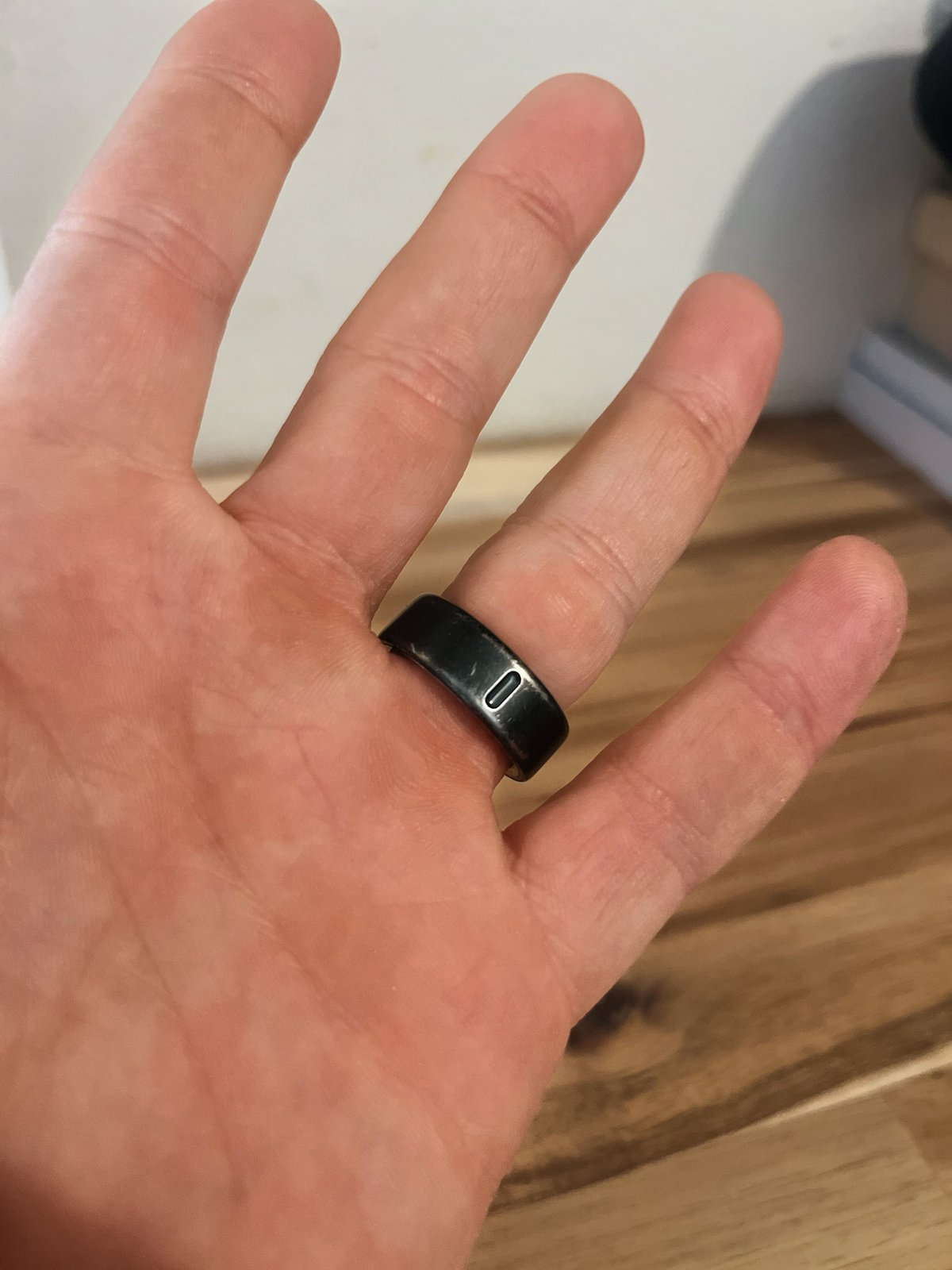
Oura Ring Gen 4
The Oura is the piece that ties the whole system together, and it does it without making a sound.
It replaced my wedding ring. That's not a small detail. I went from wearing something "dumb" on my finger to wearing a screenless wearable that captures sleep, recovery, heart rate variability, body temperature, and blood oxygen — and it still just feels like a ring. It doesn't vibrate. It doesn't light up. It doesn't feel like wearing a measurement device. It just does its job.
I trust it for recovery data more than I trust the Garmin, even though Garmin is sitting on a gold mine of potential. The Oura's sleep tracking is where the real value lives. For someone with TBI, sleep isn't just recovery — it's where the brain does its repair work. Having accurate, passive data on sleep quality, readiness, and body patterns without needing to think about it or check a screen is exactly the kind of tool this kit was built around.
But here's the bigger reason I call the Oura the "key" device in this system. I believe it may be the thing that helps me uncover internal patterns that other wearables simply can't find. The stuff happening under the surface — trends in HRV, temperature shifts, recovery scores that correlate with neurological load — that's the data I want. Not another notification. Not another graph I have to check mid-day. Just a ring on my finger, quietly collecting the signals that might actually tell me something useful about how my brain is operating.
Tactical Note: Screenless Is the Feature
Most wearables compete to be the thing on your wrist. The Oura competes by not being noticeable at all. For a TBI brain managing cognitive load, that's not a limitation — it's the entire selling point. The data exists when you want it (in the app, on your terms). It never interrupts you to deliver it.
The Notebook: Analog Isn't Optional
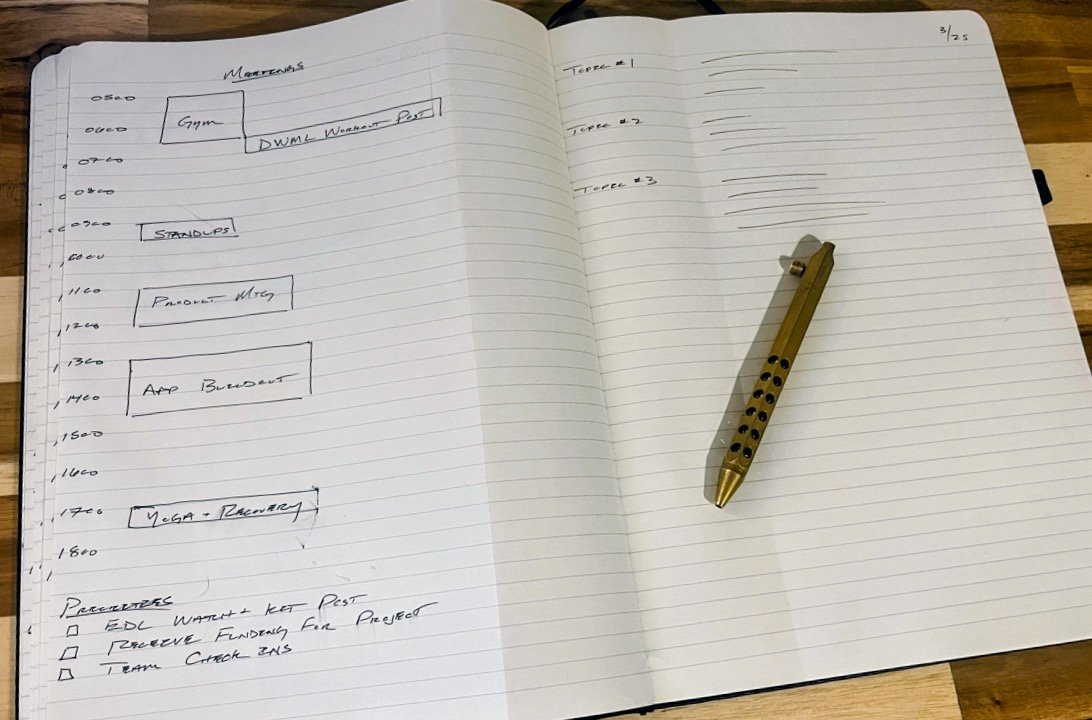
Daily Notebook
This is the most important piece in the kit. Not the most expensive. Not the most technical. A notebook. But for me, it's the difference between a functional day and a train wreck.
If I don't map out my day before leaving for work, the rest of the day is a mess. That's not a productivity tip — that's a neurological reality. My brain doesn't hold the full picture on its own the way it used to. So every morning, the left page of the open notebook gets the day's operational plan: schedule, workouts, meetings, priorities. The right page stays blank until the day starts, and then it becomes real-time capture — notes from calls, ideas that need to land somewhere, things I'll forget if I don't write them down within 30 seconds.
The reason it's a notebook and not a phone app isn't nostalgia. Handwriting activates different neural pathways than typing. The research backs this up — studies on handwriting and memory encoding show that the physical act of writing by hand engages motor regions, spatial processing, and deeper encoding circuits in ways that keyboard input simply doesn't. When you write something down with a pen, your brain processes it more thoroughly. You remember it better. You understand it more deeply.
For a brain that struggles with encoding and retrieval, that difference isn't academic. It's functional. The notebook isn't a preference. It's a cognitive prosthetic — an external tool that compensates for an internal deficit. I've tried going digital. I always come back to the notebook, because my brain holds onto what I write in a way it just doesn't when I type.
Tactical Note: The Pen Is a Medical Device
If you have TBI and you're not writing things down by hand, try it for a week. Not as a journaling exercise — as a functional recovery tool. Map your day on paper before it starts. Take notes by hand during meetings. See if the information sticks differently. For me, it changed everything.
How It All Fits Together
None of these items exist in isolation. The kit is a system, and the system has one job: protect cognitive bandwidth while still capturing the data that matters.
Here's how the pieces connect:
- The Garmin handles high-data capture during the one window where I want it — training. Then it goes away.
- The G-Shocks hold the line the rest of the day — time on your wrist, silence everywhere else.
- The Citizen carries the professional and personal weight for the days that call for it.
- The Oura runs 24/7 in the background, capturing recovery data without ever interrupting the foreground.
- The notebook handles the cognitive heavy lifting — planning, capturing, encoding — through the only medium my brain truly trusts.
Together, the system covers training data, daily timekeeping, recovery tracking, and cognitive support — without a single uninvited notification reaching my wrist. That's the point. Every tool has a role. Every role has a boundary. Nothing bleeds into the next lane.
| Tool | Function | Why Analog/Passive Wins |
|---|---|---|
| Garmin epix Pro Gen 2 | Workout data capture | On during sessions only, off otherwise |
| G-Shock 6900 / 5610 | Daily timekeeping | Zero notifications, zero cognitive cost |
| Citizen Eco-Drive | Professional / sentimental | Solar, simple, carries personal history |
| Oura Ring Gen 4 | 24/7 recovery tracking | Screenless, passive, replaces wedding ring |
| Daily Notebook | Planning + real-time capture | Handwriting encodes memory, no screen |
Build Your Own
This kit works for me. Yours won't look the same, and it shouldn't. The specific watches and ring don't matter. What matters is the framework — the idea that every tool you carry should earn its place by either capturing useful data or reducing noise. If it doesn't do one of those two things, it's spending your bandwidth for nothing.
Here's how to think about building your own version:
- Audit your wrist. Is your current watch adding value or adding noise? If it buzzes more than it helps, that's a problem.
- Separate your tools by window. Workout tracking doesn't need to be on your wrist 24/7. Define when each tool is active and when it goes away.
- Find your passive layer. Something that captures data without requiring your attention. For me it's the Oura. For you it might be something else. The key is screenless and silent.
- Write things down by hand. Seriously. Even if you don't have TBI, the encoding benefit of handwriting is real. If you do have TBI, it might be the most impactful change you make.
- Treat your attention like a budget. Every notification is a withdrawal. Every silent tool is a deposit. Run a surplus.
You don't need to spend a lot of money. A $50 G-Shock, a $5 notebook, and the decision to turn off your smartwatch notifications would get you 80% of the way to this system. The gear isn't the point. The filtering is the point.
Assessment
I didn't build this kit because I'm a watch guy who happens to have TBI. I built it because TBI forced me into a deliberate relationship with technology that most people never have to think about. What gets access to your attention, when, and why — those aren't lifestyle questions for me. They're operational ones. Getting them wrong has consequences that show up as brain fog, lost hours, and days that fall apart by noon.
Every piece in this kit is a filtering decision. The Garmin is a door that opens during training and closes after. The G-Shocks are a wall that nothing digital gets through. The Citizen is a reminder that some things carry weight no sensor can measure. The Oura is a quiet scout, collecting intelligence in the background. And the notebook is the foundation — the one tool that takes what's in my head and makes it real in a way my brain can actually hold onto.
If you're living with TBI, or concussion history, or just a brain that feels overloaded by modern tech — take a hard look at what's on your wrist and in your pocket. Ask yourself honestly: is this tool serving me, or am I serving it?
The answer might change what you carry tomorrow.
Sources
- Mueller, P.A. & Oppenheimer, D.M. "The Pen Is Mightier Than the Keyboard: Advantages of Longhand Over Laptop Note Taking." Psychological Science, 2014. PubMed 24760141
- van der Meer, A.L.H. & van der Weel, F.R. "Only Three Fingers Write, but the Whole Brain Works: A High-Density EEG Study Showing Advantages of Drawing Over Typing for Learning." Frontiers in Psychology, 2017. PMC5422512